
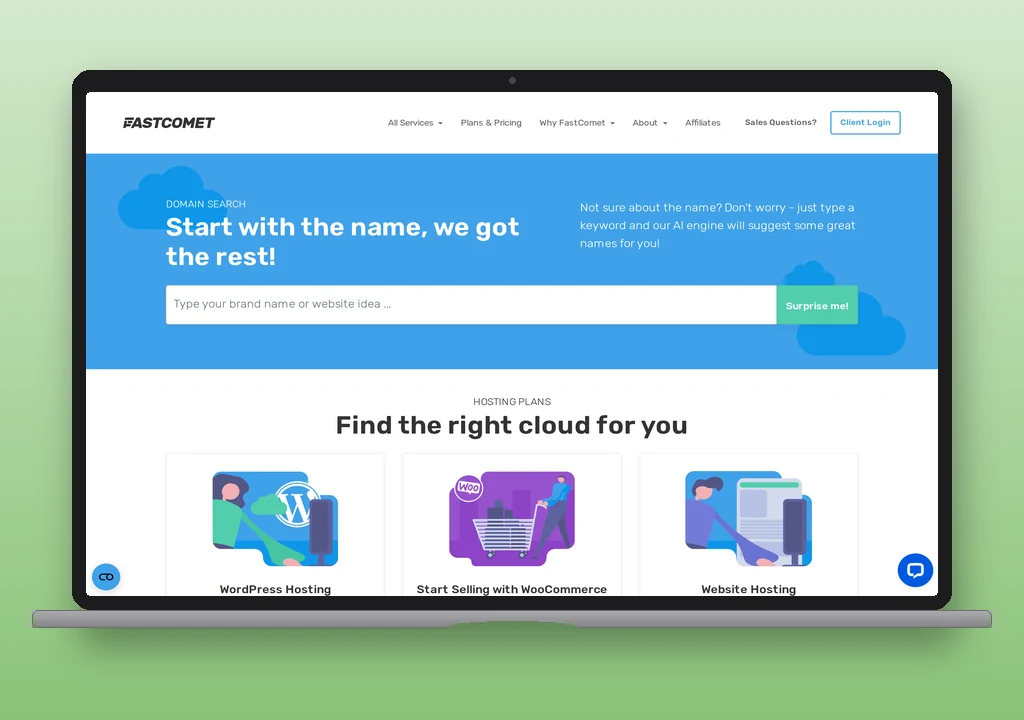
FastComet is a shared cPanel host founded in 2013 by Georgi Yanev and acquired by World Host Group (WHG) in April 2025. Unlike WHG’s other major hosting acquisition (A2 Hosting, which was rebranded to Hosting.com), FastComet continues to operate under its own brand on its own domain. Shared plans bundle domain email through cPanel with mailbox counts that step up by tier (5 on Starter, 25 on Essential, unlimited on Plus and Extra), and outbound mail is filtered through SpamExperts, the layer FastComet documents as its anti-spam stack. Standard cPanel mail ports are open and FastComet does not publish an external-SMTP block, so a third-party relay can connect via SMTP credentials without the API-only workaround that Hosting.com requires. FastComet does not publish an explicit per-hour sending limit, so the operational ceiling is whatever the outbound filter allows.
Starter renews at $9.95/month (intro $1.99/month); Essential, Plus, and Extra tiers renew at $12.95, $17.95, and $24.95 respectively. FastComet sits in the entry shared-hosting band, similar in position to Hosting.com and well below the managed-WordPress tier that Kinsta and WP Engine occupy.
Email on FastComet
How wp_mail works by default
A fresh WordPress install on a FastComet shared plan sends mail through PHP’s mail() function, which hands off to the server’s local exim configuration. FastComet’s outbound mail then passes through SpamExperts before reaching the recipient: SpamExperts holds messages flagged as outbound spam in a queue and forwards the rest. The result for an operator who has not configured anything is that WordPress’s password resets and order confirmations go out via cPanel and are spam-filtered on the way out, which is a useful default but does not, on its own, authenticate the messages.
DKIM signing (the cryptographic signature receiving mail servers use to confirm a message came from the expected domain) is configured per mailbox in cPanel’s Email Deliverability panel; FastComet’s tutorial describes a one-click “enable and repair” flow that handles SPF and DKIM together when the domain’s DNS is managed through cPanel. The signature only attaches when the message leaves from a From-address that matches a cPanel mailbox with DKIM enabled. A fresh WordPress install’s default From address (wordpress@<domain>) does not correspond to a real cPanel mailbox, so the first deliverability fix most operators make is to create the matching mailbox and enable DKIM for it, or to route WordPress through an SMTP plugin pointed at a real cPanel mailbox.
Outbound SMTP port status
| Port | Status | Protocol |
|---|---|---|
| 25 | Open (no policy block published) | SMTP (legacy) |
| 465 | Open | SMTPS (implicit TLS) |
| 587 | Open | SMTP with STARTTLS |
| 2525 | Open | SMTP (alternate) |
| 993 | Open | IMAPS (incoming, bundled mailboxes) |
| 995 | Open | POP3S (incoming, bundled mailboxes) |
FastComet does not publish a port-blocking policy of its own and does not advertise an external-SMTP restriction. Third-party SMTP plugins routinely connect from FastComet shared accounts to outside services like Postmark and SMTP2GO without trouble, on 465 or 587. This is the major operational difference between FastComet and its WHG sibling Hosting.com: the same shared-cPanel building blocks, but no external-SMTP block on top.
The trade-off is that the outbound filter (SpamExperts) handles the spam-protection job that the external-SMTP block does at Hosting.com. SpamExperts is described as queueing messages flagged as spam rather than rejecting them outright, so an operator whose WordPress install starts spewing emails (typically a sign of a compromise) will see traffic stall rather than bounce. Recoverable, but worth knowing about.
Sending limits
Not documented. FastComet does not publish a per-hour or per-day sending limit in its KB. Outbound traffic flows through SpamExperts, which applies its own throughput and reputation-based filtering; per-mailbox quotas are configurable in cPanel by the account holder. Third-party guides have cited a 200-per-hour figure, but that number is not in FastComet’s own documentation and is not reproduced here. The practical ceiling is whatever SpamExperts allows for the account’s reputation and traffic shape.
For reference, SiteGround publishes 400 per hour on its entry plan, DreamHost publishes 100 per hour per address, and Hosting.com publishes 100 per hour, 2,400 per day across all plans. FastComet’s undocumented-but-real ceiling is the missing-number version of the same constraint.
Mailboxes, forwarding, DNS
FastComet gives the operator a tiered mailbox count rather than unlimited inboxes across the board. Starter ships with 5 mailboxes, Essential with 25, and Plus and Extra both ship unlimited. Each mailbox lives under cPanel, with webmail (Roundcube), IMAP, POP3, and SMTP access. Per-mailbox storage is set against the plan’s total disk allocation (10 GB on Starter, 40 GB on Extra) rather than as a separate quota; the operator allocates per-mailbox limits in cPanel.
Mail clients on phones and laptops connect on the standard IMAPS (993) and POP3S (995) ports without anything extra to configure. Email forwarders and catch-all addresses are part of the same cPanel panel; no separate forwarding service is needed.
FastComet runs the domain’s DNS by default for domains registered or pointed through the account, which is what lets cPanel’s Email Deliverability tool publish SPF (the DNS record that authorises which mail servers can send on behalf of a domain) and DKIM records automatically through the one-click enable/repair flow. If DNS has been moved elsewhere (Cloudflare is the common one), the panel falls back to displaying the records as text for manual addition at the DNS provider.
Authentication (SPF, DKIM, DMARC)
Default SPF for SpamExperts-protected domains:
v=spf1 a:5817.submission.antispamcloud.com a:release.antispamcloud.com -all
 FastComet email deliverability tutorial
The default SPF record FastComet publishes lists the SpamExperts outbound submission and release hosts rather than a generic shared-mail-server include. The -all qualifier at the end is a hard fail, meaning receivers should reject mail that does not match. The cPanel Email Deliverability panel’s one-click flow publishes both SPF and DKIM together when FastComet manages the domain’s DNS, and DKIM signing operates per mailbox once enabled. DMARC is not published automatically; the operator publishes it manually after deciding on a policy.
The detail to watch when adding a third-party mailer later: the default SPF lists SpamExperts only. If WordPress is routed through Postmark, SMTP2GO, Mailgun, or any other service, the third-party’s include domain has to be added to the SPF record alongside the SpamExperts entries, or the new service has to be allowed in by replacing FastComet’s default record entirely. The SPF merger folds the relay’s include into the existing SpamExperts record (or into a replacement record) and counts the DNS lookups against RFC 7208’s ten-lookup ceiling before publish. Once the record is live, the DNS auth checker reads how the domain’s SPF, DKIM selector, and DMARC resolve from the receiver’s perspective, so a stale nameserver or a missed include shows up before real traffic does.
What FastComet does not provide
- A dedicated sending IP address. Outbound goes through SpamExperts’s pooled IPs, shared with every other FastComet site and other SpamExperts customers. Sites that need to insulate their deliverability need a sending service with a dedicated IP add-on: Postmark on the Dedicated IP add-on, Mailgun on its Foundation plan, SendGrid on Pro.
- Bounce tracking, suppression lists, and delivery events. SpamExperts handles the outbound filter but does not expose per-message events back to the operator. There is no log of which messages bounced, no suppression list, no open or click tracking. Mailgun and Postmark publish those events as they happen.
- A published sending limit. Operators planning around throughput cannot find a number; the ceiling is set by SpamExperts in practice. Sites with predictable burst volume need a relay with documented quotas.
- Detailed sending logs the operator can search. SpamExperts holds a queue but does not expose it in cPanel as a per-message log. Third-party services do.
- Marketing or bulk email allowance. No documented quota for campaign traffic; the SpamExperts filter is built for transactional flows. Newsletters and campaigns belong on a dedicated platform.
When a third-party relay is needed
The FastComet default path covers personal blogs and small WooCommerce stores whose transactional volume is unpredictable but modest, where the WordPress From address matches a real cPanel mailbox with DKIM enabled, and where shared SpamExperts IPs deliver acceptably. Most other shapes need a third-party relay. The triggers:
- You need a documented throughput ceiling. FastComet does not publish one. A site that needs to know its limits in advance needs a relay that publishes its own. Postmark is the cleanest fit for transactional sites under 100,000 messages a month; SMTP2GO is the cheapest credible option; Mailgun becomes economical at higher volumes.
- A missed A transactional email is the automated message a WordPress site sends in response to a single user action – a password reset, an order confirmation, a form receipt – addressed to the user who triggered it. Read full reference → costs money. Sites where a failed password reset means a churned customer cannot depend on shared SpamExperts IPs and SpamExperts’s queueing behaviour.
- You need delivery visibility. SpamExperts produces no per-message events for the operator. Any third-party service with an HTTP API or per-event webhook does.
- You’re sending newsletters or campaigns. The bundled path is built for transactional flows; bulk belongs on a dedicated marketing platform.
A configuration advantage specific to FastComet: because FastComet does not block external SMTP, both SMTP-based plugins (WP Mail SMTP, FluentSMTP, Post SMTP) and API-based integrations work without modification. SMTP is simpler to set up; API integrations hold up better when network or DNS conditions change.
Verdict
FastComet is a reasonable pick for operators who want shared cPanel hosting with bundled domain email and can live with the post-acquisition mailbox tiering. The SpamExperts outbound filter is a useful default (better than raw PHP mail() on a shared IP), but the lack of a published sending limit is the catch: operators planning around throughput have no number to plan against. The open SMTP ports and no-external-block policy make adding a relay frictionless when the bundled path isn’t enough, which is the major operational advantage over WHG’s other major shared host, Hosting.com.
For the WordPress email setup that supplements FastComet’s default path, see how to configure WordPress email.
Corrections
- 2026-06-18: an earlier version cited a 200 emails/hour sending limit; that figure was carried from third-party reviews and is not in FastComet’s own documentation.