
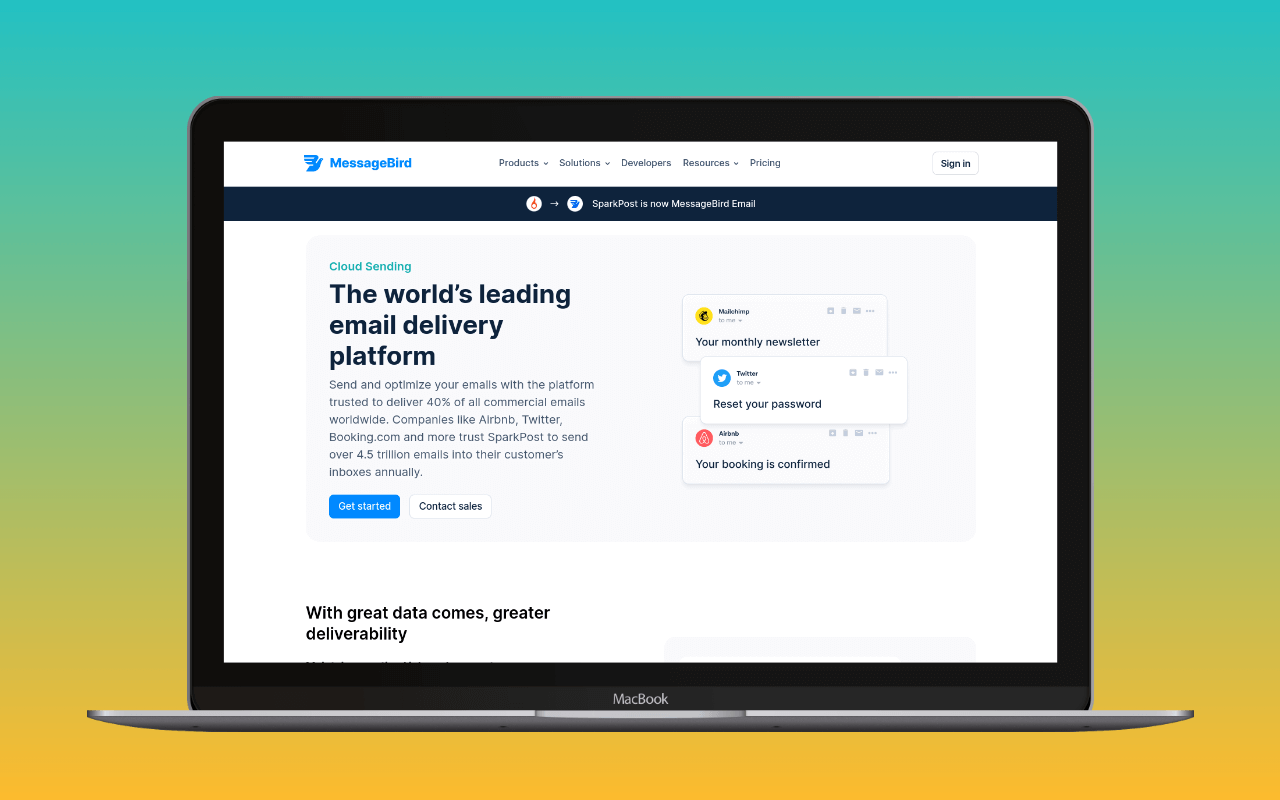
SparkPost is a A transactional email is the automated message a WordPress site sends in response to a single user action – a password reset, an order confirmation, a form receipt – addressed to the user who triggered it. Read full reference → service that launched in 2011 as the cloud version of Message Systems’ Momentum MTA. MessageBird acquired it in 2021; MessageBird then rebranded to Bird in 2024. The product now lives inside Bird as its email offering, and Bird publishes SparkPost-branded pricing at  bird.com/pricing/email?sp=true.
Self-service signup is live. The free plan sends 1,000 emails a month, no more than 50 of them in a day. Paid plans work differently from most providers here: you pay a monthly deposit into a Bird balance, and each email is charged against it at a per-1,000 rate. The $15 deposit is charged at $0.40 per 1,000, which buys about 37,500 emails. Dedicated IPs start at the $250 deposit. The WordPress plugin has not come back: the official SparkPost plugin was closed on WordPress.org in March 2025 for a security issue and has not been reinstated. WordPress sites are not stuck on generic SMTP, though. WP Mail SMTP and FluentSMTP both have their own SparkPost mailers.
SMTP settings (legacy)
The SparkPost SMTP endpoint remains documented and functional for existing accounts:
| Setting | Value |
|---|---|
| Host | smtp.sparkpostmail.com (US) or smtp.eu.sparkpostmail.com (EU) |
| Port | 587 (STARTTLS) or 2525 (alternate) |
| Encryption | STARTTLS required |
| Authentication | AUTH LOGIN |
| Username | SMTP_Injection (literal string, not your email) |
| Password | API key with “Send via SMTP” permission |
The username is always the literal string SMTP_Injection. The API key serves as the password. The WP mail config generator returns the settings for the SparkPost mailers in WP Mail SMTP and FluentSMTP, with a placeholder for your API key.
Add SparkPost’s DKIM record to your domain’s DNS before sending production email. SparkPost verifies a sending domain by that TXT record, or by a link emailed to an address at the domain, and then runs a compliance review before the domain can send. Your apex SPF record needs no SparkPost include: receivers check SPF against the Return-Path domain, which is SparkPost’s own sparkpostmail.com unless you add a custom bounce domain, a subdomain pointed at SparkPost by CNAME. Once the record is live, the DNS auth checker reads the DKIM selector the way receivers resolve it, so a stale nameserver or a mistyped selector shows up before real traffic does.
Acquisition timeline
| Date | Event |
|---|---|
| 2011 | SparkPost launched (cloud offering of Message Systems’ Momentum MTA) |
| 2016 | Free tier: 100K emails/month (made it popular with WordPress developers) |
| 2021 | Acquired by MessageBird |
| 2024 | MessageBird rebrands to Bird; SparkPost brand retired from product pages |
| March 2025 | Official WordPress plugin closed (reason: security issue) |
| July 2026 | Self-service tiers reintroduced under Bird: Starter ($20/mo) and Premier ($75/mo, dedicated IP included) |
| Checked 2 November 2026 | Bird’s card shows deposit plans ($15, $250, $1,000) charged per 1,000 emails, and a 50-a-day cap on the free plan |
Pricing (verified 2026-11-02)
Bird publishes SparkPost pricing at bird.com/pricing/email?sp=true. Apart from the free plan, nothing on it is a bundle of emails for a monthly fee. A paid plan is a monthly deposit that becomes Bird balance, and every email sent is charged against that balance at the plan’s rate from the first send:
| Monthly deposit | Per 1,000 emails | Emails the deposit covers | Dedicated IP add-ons |
|---|---|---|---|
| $0 (Free) | none | 1,000 a month, 50 a day | No |
| $15 | $0.40 | about 37,500 | No |
| $250 | $0.45 | about 555,000 | Up to 5 |
| $1,000 | $0.35 | about 2.85 million | Up to 10 |
Bird calls the email counts estimates, not included allowances. They assume the whole deposit goes on email. The balance is shared with Bird’s other products (SMS, WhatsApp and the rest), so spending it elsewhere leaves less for email. Unused balance carries forward to the next month.
The $250 plan charges more per 1,000 than the $15 plan. Its card adds a higher send rate (100 API calls a minute against 30), 500 sending domains against 10, and the dedicated-IP add-on. Bird’s card does not print a price for the add-on. For larger volumes, Bird also has a sales route to Enterprise.
The feature list is the same on every plan, Free included: the email API, SMTP relay, inbound email, templates, suppression management, open and click tracking, webhooks and 30-day message retention. The plans differ in throughput, sending domains and dedicated-IP access.
The SMTP cost calculator sets SparkPost’s $15 entry point against Postmark, SMTP2GO, Mailgun and Amazon SES at the volume the site actually sends.
Free tier
Bird lists a Free plan of 1,000 emails a month, at most 50 in a day, with no card required. Bird rejects new sends at the daily cap until midnight UTC, and at the monthly cap until the next period starts. It allows one sending domain.
The 50-a-day cap is the constraint to plan around. A store that sends 60 order emails on a sale day hits it, even when the month’s total is far under 1,000. A site whose mail spikes on busy days has a better fit in a free tier with a higher daily allowance, such as SMTP2GO‘s.
New accounts
New customers sign up with Bird, not SparkPost, and that changes the settings as well as the name. Bird’s SMTP doc lists us1.smtp.bird.com and eu1.smtp.bird.com, with the username bird and an API key as the password. Its SparkPost migration guide says SparkPost credentials do not work in Bird. Neither page says whether a Bird key works on smtp.sparkpostmail.com or with the SparkPost mailers in the plugin table below, and we have not tested it. The settings at the top of this page are for existing SparkPost accounts.
Before it has a verified domain, a new account can send only from a shared onboarding domain. Recipients must be verified members of the workspace, the default limit is 50 recipients per organization per UTC day, and Bird says production mail needs your own sending domain. That domain becomes available for sending when DKIM, the return-path CNAME and DMARC all verify. A domain left unverified for about 14 days is removed.
Bird’s docs do not describe an approval step for email, and they do not say there is none, though they say Bird may place an account under review. Nor do they say whether inactive free accounts are removed.
The tier fits a small WordPress site that sends a handful of emails a day and wants to try SparkPost’s API before putting down a deposit. It does not fit a site that needs a dedicated IP, which starts at the $250 deposit.
WordPress integration (current state)
For the step-by-step install order (API key permission, sending-domain verification, the literal SMTP_Injection username most first-day setups miss, and the region selector), see SparkPost plugin for WordPress. The section below is the plugin-path overview; the how-to is the setup walk-through.
The official SparkPost WordPress plugin (last updated August 2023, tested up to WP 6.3.8) was permanently closed on the WordPress.org repository in March 2025 due to a security issue. It is no longer available for download.
For existing SparkPost users who still have valid API credentials, connection via a general mailer plugin remains possible:
| Plugin | Method | Notes |
|---|---|---|
| WP Mail SMTP | SparkPost mailer | Sends through SparkPost’s API with an API key; US or EU region. In the free version |
| FluentSMTP | SparkPost connection | Sends through SparkPost’s API with an API key |
| Post SMTP | SparkPost mailer | Sends through SparkPost’s API with an API key; US endpoint only. In the free version |
| Easy WP SMTP | SparkPost mailer | Sends through SparkPost’s API with an API key; US or EU region. In the free version |
| YaySMTP | SparkPost mailer | Sends through SparkPost’s API with an API key; US or EU region. In the free version |
| SureMail | SparkPost mailer | Sends through SparkPost’s API with an API key; US or EU region. The plugin has no paid tier |
The API mailers skip the SMTP_Injection username entirely. The SMTP route, with manual credentials from the table above, still works in any of these plugins.
Feature coverage
SparkPost’s capability set has held up through the acquisition and is roughly the same one that made it a peer of Mailgun and Postmark at its peak:
- Delivery webhooks (bounce, delivery, open, click, spam complaint) – listed as included on every plan
- Dedicated IP addresses – an add-on from the $250 deposit plan (up to five), and up to ten on the $1,000 plan
- Inbound email – listed as included on every plan, Free included
- Template engine with Handlebars syntax
- Real-time delivery analytics (Signals)
- Email validation API
- Subaccount isolation – Bird’s current pricing card does not give a per-plan limit
Existing SparkPost accounts continue to use the same API and SMTP endpoint they always did.
Verdict
SparkPost works for a WordPress site sending directly from WordPress. Self-service signup exists, the free tier covers a site that sends a few dozen emails a day, and the $15 deposit pays for about 37,500 emails at $0.40 per 1,000. The official plugin is still closed. On an existing SparkPost account the WP Mail SMTP and FluentSMTP mailers talk to the same API, so setup is an API key and a verified domain; a new signup is a Bird account, and New accounts has what that changes.
When SparkPost fits. A site that wants to pay per email sent, at a published rate, without a fixed monthly bundle it may not use. Unused deposit carries forward, so a slow month is not wasted money. Existing SparkPost accounts with working API credentials keep running on the same endpoint.
When to look elsewhere. A free-tier site with busy days over 50 emails, or a low-volume site that wants a dedicated IP without the $250 monthly deposit that unlocks the add-on.
Alternatives worth comparing:
- SMTP2GO for the closest self-service equivalent with a generous free tier and simple setup.
- Postmark for deliverability-focused transactional email with a dedicated plugin.
- Mailgun for developers who want API-first infrastructure in the same general category.
For the broader setup that places SparkPost (or any provider) inside the WordPress email stack, see the WordPress email setup guide.
Corrections
- 2026-11-09. An earlier version told readers to add SparkPost’s SPF include to their domain’s SPF record. SparkPost verifies a sending domain by its DKIM record and a compliance review, and SPF is checked on the Return-Path domain, which is SparkPost’s own unless you add a bounce domain.
- 2026-11-05. An earlier version said the WP mail config generator took the
SMTP_Injectionusername and API key and returned a block for WP Mail SMTP, FluentSMTP or Post SMTP in Other SMTP mode. The generator takes no credentials: it returns settings for the SparkPost mailers in WP Mail SMTP and FluentSMTP with the key left as a placeholder, and it does not produce Post SMTP settings. - 2026-11-05. An earlier version listed Post SMTP as SMTP only. Post SMTP sends through SparkPost’s API with its own mailer, and so do Easy WP SMTP and YaySMTP.
- 2026-11-02. An earlier version said no mailer plugin had a dedicated SparkPost integration, so WordPress could connect only over generic SMTP. WP Mail SMTP (checked at 4.10.3) and FluentSMTP (checked at 2.4.1) both have SparkPost mailers that send through its API.
- 2026-10-21. An earlier version dated MessageBird’s acquisition of SparkPost to 2022. MessageBird announced the deal in April 2021, and Bird’s own account dates it to 2021.
- 2026-10-04. Pricing refreshed. This refresh recorded Startup (from $15/mo at 50,000 emails) and Growth (from $80/mo at 100,000), both driven by a volume slider, in place of the Starter ($20/mo) and Premier ($75/mo) tiers the July review listed; we do not know when Bird made that switch. Bird’s pricing page then listed an overage rate of $0.90 per 1,000 emails and a 5x default overage ceiling, and the dedicated IP moved from included-at-Premier to a $24.95/month add-on on Growth and above. Log retention is now stated as 30 days on all plans (previously documented historically at 10 days). Pricing section, lead, feature coverage, verdict, and acquisition timeline reworked. Bird has since replaced these terms with deposit plans, seen on its card on 2026-11-02; the date of that change is not known.
- 2026-07-06. Pricing and framing refreshed. An earlier version of this page said SparkPost was enterprise-only and no longer available as a self-service product. Bird has since reintroduced self-service Starter ($20/mo) and Premier ($75/mo, dedicated IP included) tiers alongside a 1,000-emails/month free entry point. Verdict, lead, and pricing section rewritten to match.